Reviews / O istorie naturală a exercițiului fizic (Exercised) review: the book that explains why the human body is built for movement, but the brain prefers the sofa
O istorie naturală a exercițiului fizic (Exercised) review: the book that explains why the human body is built for movement, but the brain prefers the sofa
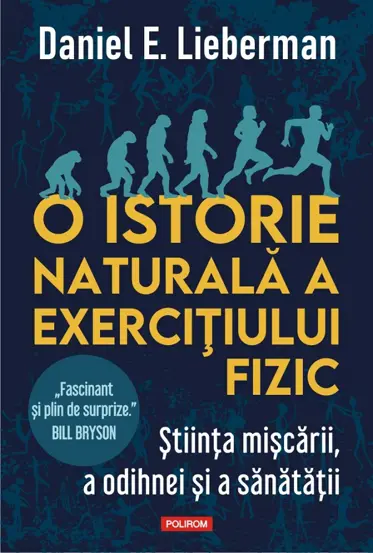
Exercised by Daniel E. Lieberman – published in Romanian as O istorie naturală a exercițiului fizic – is one of the most fascinating and important books on the human body, running, health and movement written in recent years. Instead of treating sport as a simple modern activity, the book looks at exercise through the lens of evolution and explains why humans are at the same time extremely well adapted for endurance effort and surprisingly inclined to save energy. Lieberman covers running, sedentary living, modern shoes, biomechanics, sweating, ageing, metabolism and health in an accessible, intelligent and scientifically well-argued way. The result is a book that radically changes how you see sport and your own body.
Video (YouTube Shorts)
👍 Pros
- Explains exercise through evolutionary biology and anthropology, not just modern fitness
- Lots of memorable ideas about running, biomechanics and the human body
- Demolishes popular myths about sedentary living, shoes and sport
- Accessibly written, even for people without a medical background
- Highly relevant for runners, triathletes and endurance athletes
- Helps you understand why motivation for exercise is so complicated
- Combines science, history and real examples excellently
👎 Cons
- Some chapters are denser and more academic than a typical sports book
- Offers no concrete training plans or quick fixes
- May seem counter-intuitive to people used to modern fitness messaging
- The book’s pace is analytical rather than motivational
Verdict
Exercised is one of the most valuable books you can read if you want to understand how the human body works and why our relationship with sport is so paradoxical. Daniel Lieberman does not just tell you to move. He explains why the human body evolved for endurance effort, why the brain constantly tries to save energy and how the modern lifestyle conflicts with our biology. For Tribro readers, it is almost required reading.
Gallery
What Exercised is and why it is different from other sports books
Most books about sport and health start from the question: what exercise should you do to be healthier? Daniel E. Lieberman starts from a far more interesting question: why is it so hard for people to exercise, if exercise is so beneficial?
This is the central idea of the book. The human body is extraordinarily well built for effort and endurance, but the human brain evolved to save energy whenever possible. In the past, that was a survival advantage. Today, in a world of chairs, cars and abundant food, the same instinct pushes us towards a sedentary life.
The book manages to turn this perspective into a fascinating explanation of running, health, biomechanics and the evolution of the human body.
Humans evolved for endurance running
One of the most memorable chapters in the book is about persistence hunting — the theory that prehistoric humans tracked prey over very long distances until it gave in to overheating.
Lieberman explains that humans are not the fastest runners on the planet, but they are among the most efficient at sustained effort. We have several extraordinary evolutionary adaptations:
- a great many sweat glands for efficient cooling;
- relatively little body hair;
- an elastic Achilles tendon for energy economy;
- a well-developed gluteus maximus for stabilisation;
- the nuchal ligament for stabilising the head while running;
- long legs and an efficient foot arch.
The book completely changes your perspective on running. It no longer seems like just a modern hobby, but something deeply tied to the evolution of the human species.
Modern shoes and running biomechanics
One of the most discussed ideas in the book concerns modern running shoes. Lieberman explains that humans ran barefoot or with minimal protection for hundreds of thousands of years, and the human body built its own natural cushioning system.
This includes:
- the foot arch;
- the Achilles tendon;
- the calf muscles;
- the foot itself.
Heavily cushioned shoes change running biomechanics and often encourage heel striking, which alters how forces are distributed and how the body absorbs impact.
The book does not say everyone should run barefoot. On the contrary, it warns that switching suddenly to minimalism can cause serious injuries. The real message is smarter and more nuanced: biomechanics, gradual adaptation and technique matter more than marketing from the running industry.
Why exercise feels so hard for humans
Perhaps the book’s most important revelation is that humans did not evolve to exercise for the sake of exercise.
Our ancestors moved for:
- food;
- survival;
- building;
- transport;
- hunting.
Nobody went out to run 15 kilometres just for their health.
That is why our natural instinct is to save energy when there is no clear reason to spend it. Lieberman argues that this tendency is not moral laziness, but evolutionary biology.
This idea is incredibly liberating for many people. It explains why motivation for exercise fluctuates and why discipline is so important in the modern world.
Sedentary living: the real problem of the modern world
The book explains very well that the main problem is not a lack of extreme workouts, but a lack of constant movement.
In the past:
- people walked a lot;
- sat down very little;
- did light physical activity for hours on end.
Today:
- we spend an enormous amount of time sedentary;
- we concentrate all our movement into one hour at the gym;
- we live in an environment completely different from the one our bodies evolved for.
Lieberman shows that the human body works best when there is frequent, varied movement throughout the day.
Exercise and ageing
Another very interesting chapter is about ageing. Lieberman explains that exercise does not stop ageing, but it can dramatically change how we age.
Movement tells the body that:
- muscle mass needs to be maintained;
- the cardiovascular system is worth supporting;
- bone density is still needed;
- the body needs to be repaired and maintained.
This is one of the best explanations of the real long-term benefits of exercise: we do not become immortal, but we stay functional for much longer.
Running and the myth of ruined knees
Lieberman also discusses one of the most popular myths in sport: the idea that running inevitably destroys your knees.
The book presents evidence that moderate running does not automatically cause osteoarthritis and that a sedentary lifestyle may even be more problematic for joint health.
The important message is that:
- how you build volume;
- recovery;
- technique;
- biomechanical robustness
matter far more than the simple fact that you run.
Rest is just as natural as movement
Another very valuable idea is that humans did not evolve to be active non-stop.
In nature there was:
- a lot of movement;
- but also a lot of recovery.
Lieberman subtly criticises the modern culture that glorifies permanent exhaustion and extreme training without adequate recovery.
His message is very balanced: the human body works best when there is both stress and recovery.
Who this book is for
Exercised is an excellent book for:
- runners;
- triathletes;
- endurance athletes;
- people interested in health;
- anyone who wants to understand the human body beyond modern fitness;
- readers passionate about evolutionary biology and anthropology.
It is not just a book about sport. It is a book about how evolution continues to shape our everyday lives.
What sets this book apart from other sports books
A great many fitness books tell you what to do. Lieberman explains why humans work the way they do.
That is the huge difference.
Instead of:
- superficial motivation;
- quick hacks;
- promises of instant transformation;
you get:
- evolutionary context;
- biological explanations;
- a long-term perspective;
- a much deeper understanding of the human body.
The book makes you see running, sedentary living, recovery and health completely differently.
Conclusion: is Exercised worth reading?
Yes, without a doubt. It is one of the smartest and most memorable books on movement and health published in recent years.
Daniel Lieberman achieves something rare: he combines serious science with an accessible, captivating style. The book does not just inform – it genuinely changes how you understand the human body and its relationship with sport.
For Tribro, the verdict is very clear: if you run, do triathlon or simply want to understand why movement is so important and yet so difficult in the modern world, this is almost required reading.
Note: Retailer links may be affiliate links. Prices and availability may change.