Reviews / Născuți să fim în mișcare (Built to Move) review: the 10 principles that help you move better, age better and live less stiffly
Născuți să fim în mișcare (Built to Move) review: the 10 principles that help you move better, age better and live less stiffly
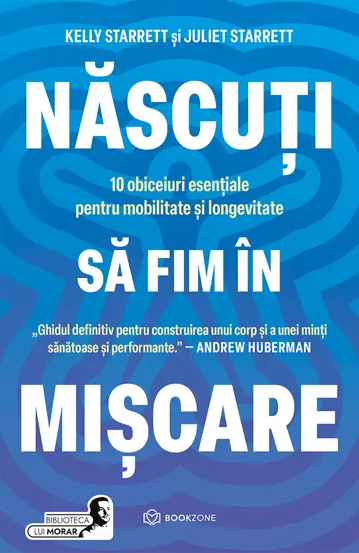
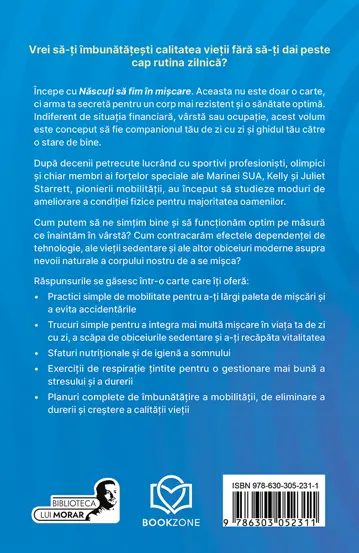
Built to Move by Kelly Starrett and Juliet Starrett – published in Romanian as Născuți să fim în mișcare – is one of the most useful books on mobility, active living and functional longevity you can read if you do sport or simply do not want to feel stiff. The book is built around 10 simple tests and 10 related practices: from your ability to get down to and up from the floor, to daily walking, breathing, sleep, squatting, balance and time spent sitting. It is not a book of cheap motivational fitness, but a very practical guide for ordinary people, amateur athletes and athletes who want a more resilient body that is more useful in real life.
Video (YouTube Shorts)
👍 Pros
- Very practical: each chapter starts with a simple test and offers clear actions
- Extremely useful for sedentary people, amateur athletes and endurance athletes
- Connects mobility to real life, not just to the gym or abstract stretching
- Covers not only joints, but also walking, breathing, sleep, nutrition and time spent on the floor vs on a chair
- Easy to turn into small daily habits, without a complicated programme
- Very good for prevention: stiffness, pain, lack of energy, poor mobility
👎 Cons
- Some ideas are repetitive if you already follow The Ready State content or the mobility space
- Not every reader will apply all 10 practices straight away
- For some advanced athletes, the basics may seem too accessible
- It is not a book focused strictly on sports performance, but rather on function and longevity
Verdict
If you have a sedentary job, do triathlon, running or the gym, or simply feel you move worse than you should, Built to Move is worth reading. It does not promise miracles, but it offers something more valuable: a simple system for assessing your body and rebuilding your ability to move well. For the reader, the book’s big message is clear: mobility is not a whim, but a foundation for health, performance and long-term independence.
Gallery
What Built to Move is and why it deserves attention
Built to Move (published in Romanian as Născuți să fim în mișcare) was written by Kelly Starrett and Juliet Starrett. The premise is simple and powerful: the human body is made to move frequently, in varied and efficient ways, and many modern aches, stiffness and limitations appear not because we inevitably age badly, but because we live in a way that takes us out of our natural movement patterns.
The book is built around 10 tests and 10 essential habits. You do not have to be an athlete to use it. In fact, that is exactly its strength: it translates mobility into simple, applicable language that is easy to fit into a normal life.
Principle 1: the Sit-and-Rise Test – the ability to get down to and up from the floor
The first principle is one of the most powerful in the whole book: if you can no longer get down to and up from the floor efficiently, you are losing a basic human function. The Sit-and-Rise Test checks hip mobility, trunk control, balance and coordination.
For the everyday reader, the message is clear: spend less time exclusively on chairs and more time on the floor, in varied positions. For athletes, this principle is extremely relevant for basic mobility, for the hips and for keeping freedom of movement over the long term.
Principle 2: the Breath-Hold Test – better breathing, less stress, a more functional body
The second principle focuses on breathing. The Breath-Hold Test is not just about how long you can hold your breath, but about how efficiently you breathe, how well you tolerate carbon dioxide and how much your breathing affects your posture, tension and calm.
Starrett explains why slow, spacious nasal breathing is a sign of better body function. In practice, this helps with both managing stress and moving well. For runners and triathletes, this part is very valuable, because it links mobility to performance and recovery, not just to stretching.
Principle 3: the Hip Agility Couch Test – hip extension and modern life on a chair
One of the most important chapters for sedentary people is the one on hip extension. If you spend many hours on a chair, your body stays in flexion too much. The Couch Test checks exactly this limitation.
What the book shows very well is that stiff hips do not just mean local discomfort. They affect walking, running, posture, lower-back pain and even how you stand up, bend over or produce force. For endurance athletes, this chapter is essential: a hip that extends poorly means worse movement economy and often unnecessary compensations.
Principle 4: the Steps-per-day Test – daily walking as the foundation for mobility and longevity
The book treats walking not as a trivial activity, but as health infrastructure. The Steps-per-day Test forces you to face reality: how much do you actually move on an ordinary day?
For a great many people, this is the chapter with the biggest return. If you walk more, you have a better chance of improving your circulation, exercise tolerance, weight control, sleep quality, mental state and tolerance for standing. For anyone searching online for the benefits of daily walking, a book about mobility or how to get rid of stiffness, this chapter answers directly and usefully.
Principle 5: the Arms Raise and Shoulder Rotation Test – functional shoulders, not just pain-free ones
The fifth principle shifts the focus to the shoulder girdle, the thoracic spine and shoulder rotation. In real life, good shoulder mobility means being able to raise your arms overhead without compensating, having better posture and reducing the tension caused by sitting at a desk, laptop and phone.
Kelly and Juliet Starrett take the discussion beyond a simple “do some stretching”. They connect shoulder mobility to control, position and postural hygiene. For swimmers, triathletes and anyone who sits at a desk a lot, this chapter has immediate practical value.
Principle 6: the Eating Test – nutrition as support for movement and healthy tissues
The book does not ignore food, but approaches it in a very pragmatic way. The Eating Test looks mainly at two things: enough micronutrients from fruit and vegetables and enough protein to maintain and repair tissues.
This is one of the best parts of the book: it does not turn nutrition into an ideology, but into support for a body that has to function. If you want better mobility, better recovery and less fragility, you cannot ignore your nutritional basics.
Principle 7: the Squat Test – the deep squat as a sign of mechanical health
The Squat Test is another very strong chapter, and one that answers questions many people search for, such as why they cannot sit in a deep squat or why their ankles and hips hurt when they go down. The book treats the deep squat as a fundamental human skill, not just a gym exercise.
If you cannot sit comfortably in a deep squat, there may be limitations at the ankle, hip, trunk or in overall coordination. Starrett offers simple ideas: time spent in the position, gradual support and frequent re-exposure. For athletes, this principle helps not only with mobility, but also with control and tolerance in the lower chain.
Principle 8: the Balance Test – balance, proprioception and real prevention
The Balance Test may seem trivial, but it is not. Balancing on one leg, including with your eyes closed, says a lot about body control, foot health, ankle function and overall resilience.
This is an excellent chapter for functional longevity. If you lose balance, you lose not only performance but also safety. For runners and triathletes, this section has direct value for stability, economy and prevention.
Principle 9: the Sitting Inventory – the real problem is not just a lack of exercise, but too much sitting
One of the most topical chapters is the Sitting Inventory. Its central idea is very important: one hour of training does not automatically cancel out a whole day spent on a chair.
The book makes you look honestly at how much you sit and in what conditions. The solution is not perfectionism, but more variation: different postures, breaks, standing, the floor and movement spread throughout the day. For a wide audience, this chapter is probably among the easiest to apply and among the most valuable.
Principle 10: the Sleep Hours Count – sleep as a multiplier for mobility, recovery and energy
The final principle moves the discussion to sleep. The Sleep Hours Count seems less like “mobility” at first glance, but it fits perfectly into the book’s logic: a body that does not recover well does not move well.
Poor sleep affects perceived pain, energy, coordination, stress tolerance and the body’s ability to repair tissues.
Who Built to Move is for
The book is a good fit for:
- sedentary people who want to feel less stiff;
- active people who have aches or limitations and want a better foundation;
- runners, triathletes, cyclists and people who want to stay functional;
- parents, professionals who spend a lot of time at a desk and people interested in longevity.
It is not just for athletes, and it is not just for mobility enthusiasts.
Conclusion: is Built to Move worth reading?
Yes. If you want a book you will actually use, not just finish, Built to Move is worth it. Its great quality is that it turns concepts that seem technical – mobility, breathing, hip extension, sedentary time, balance, sleep – into things you can observe and train.
For Tribro, the verdict is simple: it is one of the best book recommendations for endurance athletes and for people who want to age better. If we had to sum it all up in one idea, it would be this: the book helps you move better in real life, not just “do exercises”.
Note: Retailer links may be affiliate links. Prices and availability may change.