Reviews / Muc-Off Antibacterial Chamois Cream – full review: the chamois cream I now use on every ride
Muc-Off Antibacterial Chamois Cream – full review: the chamois cream I now use on every ride
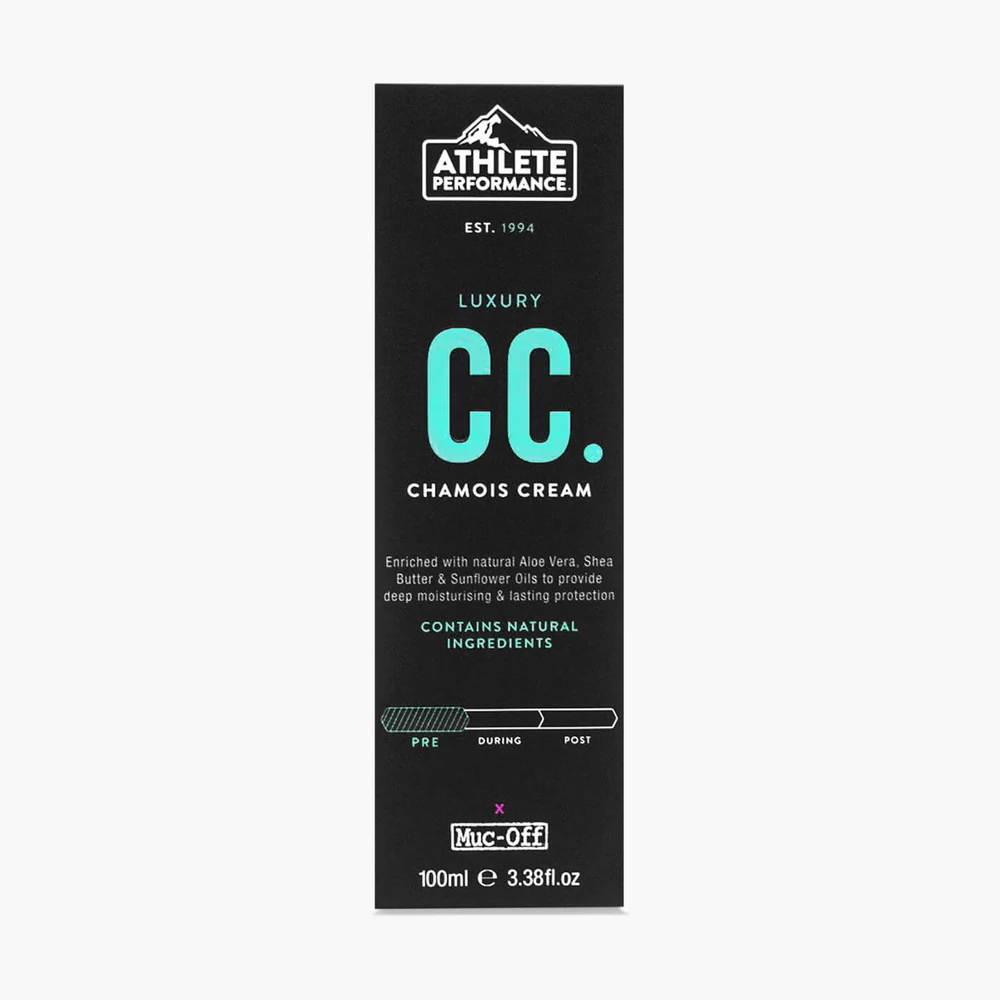
Muc-Off Antibacterial Chamois Cream is a chamois cream designed for cycling and endurance sports, intended to reduce friction, irritation and discomfort in the areas in contact with the saddle. It has a protective texture, a slight cooling effect and a formula with aloe vera, shea butter, sunflower oil and witch hazel. Since I started using it consistently on long rides, it has become one of those small products that make a surprisingly big difference.
Video (YouTube Shorts)
👍 Pros
- Very effective at reducing friction between skin, chamois and saddle
- Very useful for long rides and endurance sessions
- Thick enough to stay where you apply it
- Slight cooling effect thanks to the menthol
- Formula with aloe vera, shea butter, sunflower oil and witch hazel
- Muc-Off formulates it as an antibacterial product
- Can be applied directly to the skin or to the chamois
- The 100 ml tube is easy to take to races and on holiday
- Useful not only for cyclists, but also for triathletes and other endurance athletes
- For me, it quickly became a product I use almost automatically before long rides
👎 Cons
- 100 ml runs out fairly quickly if you use it on every ride
- The 250 ml version makes more sense for frequent use
- Contains menthol and fragrance, which may not be ideal for very sensitive skin
- Does not fix the cause of a poor riding position, an unsuitable saddle or a poor chamois
- It is one more product you have to remember to apply before heading out
Verdict
It is the kind of product you might initially consider optional and, after a few long rides, start wondering why you did not use it sooner. Muc-Off Chamois Cream does a very good job of reducing friction between skin, chamois and saddle, lasts long enough for long sessions and has a slight cooling effect that I like. My first tube has already run out and it is probably far from the last. For long rides, triathlon training and races, it has become part of my preparation routine.
Gallery
What a chamois cream actually is and why you would use one
If you have recently taken up cycling, a chamois cream is probably not the first product you think of buying. For a long time, I did not consider it essential either.
The problem appears as your rides get longer. For two, three, four or more hours, the same area is under constant pressure, sweat and movement between skin, chamois and saddle. However good your kit is, friction exists.
A chamois cream does not work like an anaesthetic, nor does it make an unsuitable saddle comfortable. Its role is much simpler: **it creates a layer that reduces friction between surfaces** and helps your skin cope better with hours on the bike.
The difference can seem small in the first hour and very big after three or four.
Why I started using Muc-Off Chamois Cream
It is one of those products I discovered relatively late considering how many hours I spend on the bike.
I first used it as just another product to try. After several long rides, though, it became part of my pre-ride routine almost without me noticing.
For me, this is probably the most relevant compliment I can pay a product like this: **the first tube has run out**.
And it is probably far from the last. On long rides, I no longer really see a reason to head out without applying a cream like this.
How Muc-Off Antibacterial Chamois Cream works
Muc-Off describes the product as a skin lubricant that creates a protective barrier in sensitive areas and reduces friction.
The formula contains, among other things:
• petrolatum
• mineral oil
• sunflower seed oil
• shea butter
• aloe vera
• witch hazel
• panthenol
• menthol
The combination explains the feel of the product quite well: it is not simply a moisturiser, but a formula designed to leave a protective layer between your skin and the fabric.
The menthol is also responsible for the slight cooling sensation you feel after applying it.
How to apply it
Muc-Off recommends applying it about **5 minutes before you head out on your ride**.
You can apply the product:
• directly to the skin, in the areas where friction occurs
• to the chamois of your cycling shorts
• or a combination of the two
I prefer applying it directly to the areas where I know friction occurs and, if a very long ride is coming, I may use a slightly more generous amount.
You do not need to turn the whole chamois into a layer of cream, though. What matters is covering the areas where skin and kit move repeatedly against each other.
How it feels during a ride
This is the main reason I kept using it.
There is no dramatic moment when you apply the cream and suddenly your bike becomes an armchair. The benefit is more subtle.
As the hours pass, you notice less friction and fewer areas starting to get irritated. In practice, you eliminate one of the small sources of discomfort that, added up over a four- or five-hour ride, can become very annoying.
For me, the difference is big enough that the cream has become part of my preparation for long rides.
The cooling effect: pleasant without being overwhelming
The formula contains menthol, and Muc-Off talks about a slight cooling effect.
The description is accurate: the sensation is there, but it is not the kind of extreme effect that distracts you or becomes unpleasant.
Personally, I like it. Especially in summer or on long sessions, the initial sensation adds to the overall feeling of comfort.
However, this may be exactly why someone with very sensitive skin might prefer a formula without menthol or fragrance.
What “antibacterial” means here
Muc-Off markets the formula as antibacterial and designs it for areas where the combination of sweat, high temperature and friction can create unpleasant conditions for the skin.
It is an interesting bonus for a product used in the chamois area, but I would not buy the cream for that argument alone.
In my opinion, the main benefit remains **reduced friction and mechanical protection for the skin**.
And very importantly: a chamois cream does not replace hygiene. After the ride, your shorts need washing and your skin needs cleaning as usual.
Is it useful for triathlon too?
Yes – and for me this is where the product makes even more sense.
In triathlon the context is somewhat harder than on a simple bike ride: you may start the bike leg with your tri suit wet from the swim, followed by dozens of kilometres in the same position.
Moisture + pressure + repetitive movement is exactly the combination in which friction can become a problem.
Muc-Off states explicitly that the formula is intended not only for cyclists, but also for triathletes, runners and endurance athletes.
For a half or full distance triathlon, a chamois cream seems to me a very cheap detail compared with how much discomfort it can prevent.
Muc-Off vs ASSOS Chamois Crème
ASSOS Chamois Crème is probably one of the best-known products in the category and a very good benchmark.
Both aim for the same thing:
• reducing friction
• moisturising the skin
• reducing the risk of irritation and saddle sores
• comfort on long rides
• a slight cooling effect
ASSOS puts a lot of emphasis on the consistency of the cream and on the fact that the formula lasts on long rides but washes out of the chamois easily.
Muc-Off adds its antibacterial positioning and a formula rich in aloe vera, shea butter, sunflower oil and witch hazel.
If you already use ASSOS and are very happy with it, there is no huge reason to switch. If you are choosing your first cream or want something with a very good protective feel and a slight cooling effect, Muc-Off is in the same league.
Muc-Off vs Chamois Butt'r
Chamois Butt'r is probably the alternative you will see mentioned most often outside Europe.
The principle is the same: it creates a barrier between your skin and your kit to reduce friction. Chamois Butt'r has the advantage of a very wide range of formulas and emphasises formulas that wash out easily and are free of artificial fragrances and colourings.
Muc-Off seems to me to lean a bit more towards a “performance” product feel: a dense formula, menthol, a cooling effect and antibacterial positioning.
For anyone with very sensitive skin who does not like menthol or fragrance, a Chamois Butt'r formula may be interesting. For long rides and a consistent feeling of protection, Muc-Off remains my choice of the two.
Muc-Off vs Morgan Blue
Morgan Blue approaches the category a little differently and even has separate formulas depending on the conditions.
Soft Chamois Cream is recommended by the manufacturer for dry weather and contains, among other things, vitamin E and several plant oils. For rain there is Solid Chamois Cream, a much simpler and greasier formula designed to hold up better in wet conditions.
That gives Morgan Blue an interesting advantage for cyclists who want products tailored to specific conditions.
Muc-Off is simpler in this respect: the same cream is promoted for long rides and varied conditions.
For normal everyday use and for triathlon, I prefer the simplicity of this approach.
Muc-Off vs cheap creams or petroleum jelly
In theory, the main goal is reducing friction, so it is tempting to say any greasy product should do the same job.
In practice, a cream made for cycling has to strike a balance between several things:
• lubricating enough
• staying on the skin
• not being excessively greasy
• working with the chamois material
• washing out reasonably well after the ride
That is why I prefer a product made specifically for this purpose. For the amount you use on a ride, the saving from choosing an improvised solution is quite small.
What a chamois cream cannot fix
It is very important not to give the product powers it does not have.
If the area in contact with the saddle hurts badly after every ride, the problem may lie elsewhere:
• an unsuitable saddle
• the wrong saddle height or position
• an incorrect bike fit
• shorts with a poor or unsuitable chamois
• too many hours on the bike without gradual adaptation
The cream reduces friction. It cannot eliminate the pressure caused by an unsuitable saddle, nor can it correct your position on the bike.
If the pain is deep, persistent or appears regardless of ride length, the first thing I would look at is not the cream, but your bike setup.
100 ml or 250 ml?
The 100 ml version has a big advantage: it is practical.
You throw it in your kit bag, take it on holiday or put it in your race luggage and it takes up almost no space.
But if you end up using it before almost every ride, as I started doing, the 100 ml tube will not last very long.
Muc-Off also makes a 250 ml version. If you already know you like the product and ride a lot, **250 ml is the more logical choice for home**, while the 100 ml tube can stay for travel and race day.
When I would use it
I do not think it is necessary to apply cream for a 30–40 minute spin.
But it makes more and more sense when we are talking about:
• rides of 2+ hours
• the weekly long ride
• trainer sessions where you sweat a lot
• very hot rides
• consecutive days of cycling
• bikepacking
• cycling races
• Olympic-distance triathlon
• half Ironman / 70.3
• full distance
The more time you spend in the saddle, the bigger the potential benefit.
Is it worth the money?
Yes.
It is one of those products that cost very little compared with the bike, the kit and everything else we buy for cycling, but it can have a direct effect on comfort.
A tube costs roughly as much as a few gels or two decent café stops, but you use it across many training sessions.
For me the equation is simple: if I spend several hours on the bike and can significantly reduce one of the main sources of discomfort with a few grams of cream, it is worth it.
Final verdict
For me, Muc-Off Antibacterial Chamois Cream has moved from the “let’s see if it helps” category to the products I use almost automatically before long rides.
It will not make your bike faster. It will not raise your FTP. It will not make your saddle better.
But after a few hours of riding it can do something almost as valuable: **remove an unnecessary reason for wanting to get off the bike**.
My first tube has run out and another one is very likely to follow. The only change is that, for regular use, next time I would buy the larger 250 ml version.
For cyclists, and especially for triathletes who spend many hours in the saddle, it is a very easy recommendation to make.
Note: Retailer links may be affiliate links. Prices and availability may change.