Reviews / Do nasal strips really help when you run? What the studies say and what Master-Aid actually does
Do nasal strips really help when you run? What the studies say and what Master-Aid actually does
Nasal strips have become increasingly visible among runners, cyclists and triathletes. The idea seems logical: they mechanically open the nasal area, you breathe more easily and perhaps you perform better. The first part is fairly well supported by physiology and studies: external nasal dilators can enlarge the nasal valve area and reduce resistance to airflow. The second part is much less certain. A meta-analysis of 19 studies found no significant improvements in VO₂max, heart rate or perceived exertion in healthy people. A meta-analysis dedicated to running found some favourable results, but the certainty of the evidence was rated very low. In cycling, a 20 km time trial produced practically the same power with or without a nasal dilator. The Tribro verdict: nasal strips can make nasal breathing feel freer and are cheap and easy to test, but there is currently no solid evidence that they make healthy athletes faster. Master-Aid is a simple example of this kind of product, with no medicinal substance, which you can test if you like the feeling of more open breathing.
Video (YouTube Shorts)
👍 Pros
- Works through a very simple mechanism: external dilation of the nasal area
- Can improve the subjective feeling of nasal breathing and nasal patency
- Contains no medicinal substance and does not require a device inserted into the nose
- Cheap and easy to test in training before deciding whether it is worth using in a race
- A study on triathletes found favourable effects on exclusively nasal breathing, including with a Master-Aid Roll-Flex product
- May make more sense for people who actually have a limitation in nasal airflow than for athletes without obstruction
👎 Cons
- There is no solid evidence that nasal strips improve sports performance in healthy people
- The main meta-analysis found no significant improvements in VO₂max, heart rate or perceived exertion
- The positive results seen in a meta-analysis dedicated to running had a certainty of evidence rated very low
- In a 20 km cycling time trial, average power was practically identical with and without a nasal dilator
- A feeling of freer breathing should not be confused with a measurable increase in oxygenation or performance
- Master-Aid Roll-Flex appears in a study on triathletes, but it should not be confused with the current Master-Aid 30-strip product
- The adhesive can irritate the skin in some people, and the product should not be applied to irritated or damaged skin
Verdict
Master-Aid is a simple product for a simple problem: it tries to keep the nasal area a little more open and can make breathing through your nose feel easier. Here the mechanism makes sense, and the literature shows that external nasal dilators can affect nasal patency. What we cannot say on the basis of current evidence is that a healthy athlete will run faster, produce more watts or raise their VO₂max because they wear a strip. For me, their usefulness lies more in the feeling of breathing comfort, especially during very intense efforts. If you feel the difference too, they are cheap enough to use. Just do not turn the sensation into a performance promise that the studies do not yet support.
Gallery
Why nasal strips have become so popular in sport
You see them more and more often at the start of running races, in triathlon, in cycling and even on professional athletes. A small strip stuck across the nose seems to have become yet another performance accessory.
The idea behind it is very intuitive: if your nose is more open, air passes more easily. If air passes more easily, perhaps you breathe better. And if you breathe better, perhaps you run or ride faster.
The first two statements have a reasonable physiological basis. The problem lies with the last one.
A more open nose does not automatically mean that your cardiovascular and muscular systems receive more oxygen or that your sports performance improves. For that, we have to look at the studies that actually measured VO₂max, power, heart rate, perceived exertion and performance.
What the nasal valve is and how a strip works
External nasal strips are surprisingly simple.
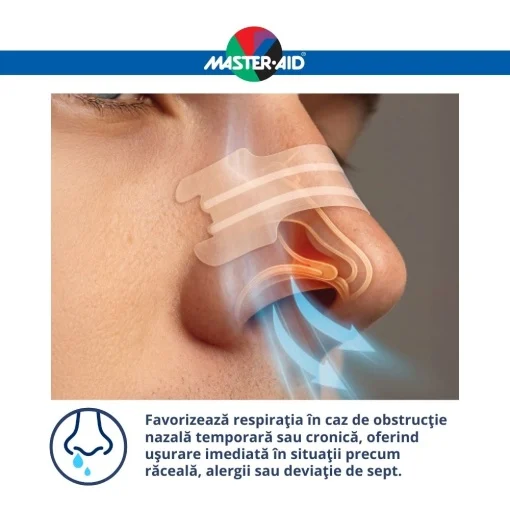
The area called the nasal valve is one of the narrowest regions of the nasal airway and contributes significantly to the resistance air meets when we breathe in through the nose.
An external nasal strip contains elastic elements that tend to return to their original shape once the strip is stuck to the nose. The resulting force gently pulls the walls of the nose outwards and can enlarge the area available for airflow.
The literature shows that external nasal dilators can increase the cross-sectional area of the nasal valve, reduce nasal resistance and help stabilise the lateral walls of the nasal vestibule during inspiration.
In other words, the strip can genuinely do something mechanical. There is no need to invoke magnets, energy flows or other exotic explanations.
What Master-Aid is and what the current product does
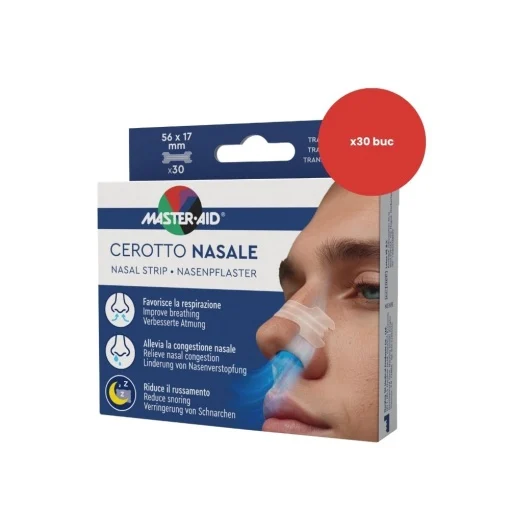
The Master-Aid product currently available in Romania is a medical device with 30 transparent nasal strips, each measuring roughly 56 x 17 mm.
According to the manufacturer and retailer, it works mechanically by gently widening the nasal airways and contains no medicinal substance. Its structure includes adhesive layers and a PET elastic element that produces the mechanical effect.
The product can be worn during the day or at night and is single-use. The recommended wear time should not exceed 12 hours a day.
For sport, the relevant part is the dilation mechanism. But we should not assume that claims such as “more efficient breathing” automatically mean a measurable improvement in performance.
The main meta-analysis: 19 studies and no clear performance advantage
One of the most important papers on this subject is the systematic review and meta-analysis published by Dinardi and colleagues in the European Archives of Oto-Rhino-Laryngology.
The researchers initially identified 624 papers and included 19 eligible studies on the use of external nasal dilators during physical exercise in the review.
For VO₂max, the meta-analysis included 168 participants and found no statistically significant difference between using the strip and the control.
For heart rate, data from 138 participants were analysed, again with no significant difference.
For perceived exertion (RPE), 92 participants were included and the result was, once again, not significant.
The authors’ conclusion was very simple: external nasal dilators did not improve VO₂max, heart rate or perceived exertion in healthy people during physical exercise.
This does not mean the strips do not open the nose. It means that opening the nose did not translate into a consistent improvement in these performance parameters.
For running there is a positive signal, but the evidence is very weak
Another meta-analysis, published in the Journal of Sports Sciences, focused specifically on running.
It included 11 articles analysing nasal dilators and parameters associated with running performance.
The authors found results favouring nasal dilators over placebo for VO₂max and perceived exertion.
It would be easy to stop here and say that strips work.
But the authors rated the certainty of this evidence using the GRADE system and classified it as “very low”.
That means we have very little confidence that the size of the observed effect reflects the real effect, and that future studies could change the conclusion considerably.
It is an interesting signal, not proof that the strip makes you faster.
On the bike we have a very easy-to-understand experiment
A randomised crossover study tested 15 trained cyclists in a 20 km time trial.
Each athlete completed the test in three conditions: with no device, with an external Breathe Right dilator and with an internal Turbine nasal dilator.
Average power was:
- 272 ± 44 W with no dilator;
- 271 ± 44 W with the external strip;
- 270 ± 45 W with the internal dilator.
In practice, the same performance.
There were no relevant differences in economy, heart rate, perceived exertion or the sensation of breathing difficulty either.
For a cyclist, the example is very intuitive: if the strip had produced a meaningful aerobic advantage, we would have expected at least part of that advantage to appear in the watts produced or in the time taken to complete the time trial. In this study, it did not.
The interesting study on triathletes and the link to Master-Aid
There is, however, a particularly interesting study for us, because it was carried out on 13 healthy triathletes.
The athletes were tested in three conditions: with no strip, with Breathe Right and with Master-Aid Roll-Flex.
The researchers measured peak nasal inspiratory flow, time to exhaustion, VO₂max, the time for which athletes could continue breathing exclusively through the nose and the subjective feeling of nasal patency.
Both dilators improved the subjective feeling of airflow through the nose. The time for which athletes could maintain nasal breathing was longer, and some measurements taken during nasal breathing improved.
This fairly well supports the idea that strips can make nasal breathing feel and work differently.
There is one important caveat, though: the product studied was Master-Aid Roll-Flex, a strip that could be cut and adapted to the anatomy of the nose. We have no grounds to claim that today’s 30-strip Master-Aid pack is exactly the same product, or that the study’s results transfer identically to it.
Easier breathing does not automatically mean more oxygen for your muscles
This is probably the most important idea in the article.
During intense exercise, aerobic performance depends on a whole chain: pulmonary ventilation, gas exchange in the lungs, the blood’s capacity to carry oxygen, cardiac output, circulation to the working muscles and the muscles’ ability to use oxygen.
In a healthy athlete, the resistance air meets in the nose is not necessarily the limiting link in this system, especially at high intensities, when breathing becomes largely oro-nasal or predominantly oral.
That is why it is perfectly possible for the strip to make your nose feel more open without producing a measurable difference in VO₂max, power or race time.
The sensation is real. The conclusion about performance does not follow from it automatically.
But what if you really do have nasal obstruction?
This is where things get more interesting.
A study published in the American Journal of Otolaryngology analysed 38 endurance athletes: 23 had nasal valve compromise and 15 did not.
The researchers used an internal nasal dilator and observed improvements in nasal patency, VO₂max, aerobic performance and the sensation of breathlessness and fatigue in the group of athletes with nasal obstruction.
These improvements were not seen in the same way in athletes without obstruction.
This is a very important result for interpreting the whole subject: if there really is a limiting factor in the nose, partially removing that limitation may matter more.
But the study used an internal dilator and a specific population, so it cannot be used as evidence that an external strip improves the performance of every healthy runner.
So why do I feel they help me?
I notice them especially on very intense runs and all-out efforts. My feeling is that I can breathe in a little more freely and that breathing feels slightly more comfortable.
This can have several explanations, and we do not have to choose artificially between “it works” and “it is placebo”.
The strip can genuinely change nasal patency mechanically. Studies on athletes have also reported an improvement in the subjective feeling of airflow.
At the same time, if I expect the product to help me, there may also be an expectation or placebo component in how I perceive the effort.
For me, that is not a problem. If the product is safe for you, costs little and you like the feeling during an all-out 5K, you do not need to prove that it adds 1% to your VO₂max in order to use it.
We just should not confuse personal experience with a universal conclusion about performance.
How I would test nasal strips in practice
I would not use them for the first time in an important race.
Try them first in a few similar training sessions: an interval session, a tempo run or a harder run with a strip, and a comparable session without one.
Do not look only at pace. Notice how freely you feel you breathe through your nose, whether the adhesive bothers you, whether it stays in place when you sweat and whether you like the sensation enough for it to be worth repeating.
If you have access to data, you can also compare heart rate or RPE, but do not turn two different runs into a clinical trial. Weather, fatigue, sleep, temperature and how you feel on the day can change performance far more than the strip.
The most valuable personal result may simply be: “I like how I breathe more with it”.
Master-Aid: is it worth roughly €6.50?
The pack of 30 Master-Aid strips currently costs around €6.50, which works out at a little over 1 leu per use.
At that price, I do not think the product needs to be treated as a serious performance investment. It is more of a very cheap experiment.
If you try it and feel absolutely no difference, there is probably no strong reason to keep buying it.
If you clearly like the sensation and use it for intervals, races or when your nose feels more blocked, the cost per use is low enough that the decision is more one of personal preference.
What I would not do is pay a big premium for a strip marketed as performance technology just because the marketing promises more oxygen or greater endurance. So far, the literature does not justify such promises for healthy athletes.
Tribro verdict: they work, but we need to define what “work” means
If by “work” we mean that a nasal strip can mechanically pull on the walls of the nose and make the nasal passage more open, the answer is yes.
If by “work” we mean that it automatically makes you faster, raises your VO₂max or adds watts on the bike, the answer based on current evidence is much more cautious.
The main meta-analysis shows no significant benefits for VO₂max, heart rate or RPE in healthy people. The cycling study found no performance advantage. The running-specific literature contains some favourable results, but their certainty is very low.
On the other hand, there are better arguments that strips can change nasal patency and the subjective sensation of breathing.
And for me, that is why they are worth trying: not for the promise that a one-leu strip will transform your physiology, but because you might simply like how you breathe more when you wear one.
Important note
This article is an analysis of the available literature on nasal dilators and a personal experience of using them. It is not medical advice.
If you have persistent difficulty breathing through your nose, a feeling that one nostril is permanently blocked, previous nasal injuries, severe allergies, significant snoring or suspected sleep apnoea, a strip does not replace identifying the cause.
The Master-Aid product should not be applied to irritated, red or damaged skin or to open wounds. The manufacturer recommends stopping use if persistent irritation or other adverse reactions occur and limits wear to a maximum of 12 hours a day.
Sources and studies mentioned
I checked the available literature and the sources below in September 2026.
• **Dinardi RR, Ferreira CHS, Silveira GS et al.** *Does the external nasal dilator strip help in sports activity? A systematic review and meta-analysis.* European Archives of Oto-Rhino-Laryngology. 2021;278(5):1307-1320. DOI: 10.1007/s00405-020-06202-5. See the study on PubMed
• **Gomes SKSP et al.** *Nasal dilator and physiological parameters associated to running performance: A systematic review and meta-analysis.* Journal of Sports Sciences. 2022. See the study on PubMed
• **Adams CM, Peiffer JJ.** *Neither internal nor external nasal dilation improves cycling 20-km time trial performance.* Journal of Science and Medicine in Sport. 2017;20(3):287-292. See the study on PubMed
• **Ottaviano G et al.** *Breathing parameters associated to two different external nasal dilator strips in endurance athletes.* Auris Nasus Larynx. 2017. The study included Breathe Right and Master-Aid Roll-Flex in 13 triathletes. See the study on PubMed
• **Valsamidis K et al.** *Improvement of the aerobic performance in endurance athletes presenting nasal valve compromise with the application of an internal nasal dilator.* American Journal of Otolaryngology. 2024;45(1):104059. DOI: 10.1016/j.amjoto.2023.104059. See the study on PubMed
• **Master-Aid – product information:** dimensions, composition, use and precautions. See the product at Farmacia Tei
**Note:** the study that used a Master-Aid product tested Master-Aid Roll-Flex. We do not claim that the 30-strip Master-Aid packs currently on sale are identical to the product used in that study.
Note: Retailer links may be affiliate links. Prices and availability may change.