Reviews / Arm warmers for running and cycling – why they are so useful when the temperature changes
Arm warmers for running and cycling – why they are so useful when the temperature changes
Arm warmers are not just a running accessory, nor a product specific to KIPRUN. Almost every endurance kit brand makes thin, thermal, UV-protective or water-repellent versions. The idea is the same: you quickly cover an area that makes up roughly 15% of your body surface without having to wear a full top or jacket. For running, they are useful at cold starts and on spring or autumn mornings. On the bike they can be even more valuable: on early starts, on evening recovery rides and especially before a long descent after a climb on which you have been sweating. The KIPRUN arm warmers are just the affordable example in this article, not the only good choice.
👍 Pros
- Quickly adapt your kit to changes in temperature and intensity
- Very useful for both running and cycling
- Can be rolled down to your wrists or stored in a pocket
- Cover a significant area, roughly 15% of body surface excluding the hands
- Allow more control than a long-sleeved top worn all the time
- Versions exist for cold, wind, light rain and UV protection
- The KIPRUN model is affordable and made of breathable material
👎 Cons
- A thin pair does not replace a jacket in cold, rain or strong wind
- The wrong size can make arm warmers slip or squeeze
- Models without a membrane provide insulation but limited wind protection
- Once wet, the material can make you feel colder on a descent
- There is no evidence that arm warmers on their own directly improve performance
- The KIPRUN model comes in only two size ranges
Verdict
Arm warmers are one of the most versatile accessories in an endurance athlete’s kit. For running, they neatly solve cold starts and cold mornings. On the bike they make even more sense, because speed and the alternation between climbing and descending can very quickly change how much heat you produce and how much you lose. Roughly 15% of your body surface is on your arms, excluding the hands, so covering them is not a negligible detail. However, the literature supports the principles of thermoregulation and the usefulness of managing your clothing, not a guaranteed performance gain from arm warmers. The KIPRUN arm warmers get 8.8/10 as a simple, affordable example; the same logic applies to many models from other brands, depending on thickness, wind protection and the conditions you use them in.
Gallery
This is not an article about a single product
The KIPRUN arm warmers are the starting point because they are simple, affordable and easy to find. But arm warmers are a whole category of kit, not a KIPRUN invention or quirk. Castelli, Sportful, Assos, Gobik, Santini, Rapha, Compressport and many other brands make their own versions.
The important differences are not the logo, but the material and purpose: there are very thin arm warmers for sun and small temperature changes, thermal models with a brushed interior, more wind-resistant versions and models treated for light rain. Some are cut primarily for cycling, others for running, but many work well in both sports.
The shared principle is a very good one: you turn a short-sleeved T-shirt or jersey into adaptable kit, without wearing a full extra layer all the time.
Why your arms matter for thermoregulation: roughly 15% of your body surface
The claim that the arms make up roughly 15% of body surface area is supported by anthropometric data, if we are talking about the arms excluding the hands. Tables based on US EPA data estimate this area at roughly 15–15.5% for men and around 13.7–14% for women, depending on the dataset and percentile analysed. The clinical rule of nines estimates the complete upper limbs, including the hands, at roughly 18% in total.
The percentage does not mean that covering your arms changes your core temperature by the same proportion. Heat exchange depends on temperature, wind, humidity, solar radiation, skin blood flow, sweating, exercise intensity and the properties of the fabric.
It does mean, however, that we are not talking about a negligible surface. Skin exchanges heat with the environment through radiation, convection, conduction and evaporation, and clothing can reduce heat loss by trapping a layer of air and limiting direct contact with moving air.
What studies can and cannot show about arm warmers
The thermoregulation literature clearly shows that skin temperature, exposed surface area, moisture, airflow and clothing affect heat exchange and thermal comfort. There is also research in which local cooling or warming of different regions changes thermal sensation or physiological responses.
This provides a solid basis for the practical explanation of arm warmers: covering the skin reduces direct exchange with cold air, while removing them increases the surface available for heat loss and evaporation.
However, I did not find a controlled study that isolates exactly the effect of an ordinary pair of arm warmers and shows that it improves running time or cycling power. The well-supported benefit is managing comfort and clothing; any direct performance promise would go further than the evidence.
For running: cold at the start, warm after the first few kilometres
Running produces a lot of metabolic heat and involves relatively low air speed compared with cycling. That is why you can feel cold before the start but regret a long-sleeved top after 15–20 minutes. Arm warmers are perfect for exactly this transition.
Analyses of endurance races show that running performance is favoured by fairly cool conditions. A study of 1,258 races linked the best performances to roughly 7.5–15°C WBGT, corresponding in the authors’ analysis to roughly 10–17.5°C air temperature. For the marathon, other studies find even lower values: an analysis of almost 1.8 million results estimated optimal temperatures between 3.8 and 9.9°C, depending on the runners’ level.
These values are not a universal recipe and do not automatically determine how you should dress. But they explain why many fast races start in conditions where bare arms can be uncomfortable before the gun, even if the temperature becomes ideal once you are running.
On the bike they can be even more useful than for running
Cycling combines heat production with much greater airflow. Even on a mild day, the air continuously passing over your skin increases convective heat exchange. When intensity drops, your thermal sensation can change almost immediately.
This is where arm warmers become exceptionally useful. You can wear them when you set off on a cold morning, roll them down once the day warms up and pull them up again if you are heading home after sunset. On a recovery ride, you produce less heat than in a hard session, so the same temperature can feel colder.
Field data from 74 professional cyclists, collected over eight years, showed an inverted U-shaped relationship between temperature and maximum power. The best values appeared across a wide range, roughly 10–25°C for the group as a whole, while extreme cold and heat were associated with poorer performance. So there is no single perfect temperature for every ride, but the extremes matter.
The classic case: a long climb, sweat, then a descent
On a long climb you produce a lot of heat at relatively low speed. You can open your jersey, roll down your arm warmers or stow them to let sweat evaporate. At the top, several things change at once: intensity and heat production drop, air speed rises and altitude may mean a lower temperature. If your clothes are damp, evaporation adds further cooling.
A study on cycling clothing used a protocol very close to reality: flat, climb and then a 20-minute “descent” at low effort with simulated wind of 16.7 m/s, in an environment of 14.5°C. The amount of clothing changed average skin and body temperature, but more clothing at every stage also came at a cost: higher sweating and heart rate. The practical conclusion is not “dress as warmly as possible”, but manage your layers according to the stage of the ride.
That is why the combination of arm warmers and a light gilet is so effective in the mountains. The arm warmers reduce arm exposure and the gilet protects your torso from the wind. Put them on before the descent starts, not after you have already started shivering.
Wind changes the problem radically on the bike
Bike speed creates airflow even when the meteorological wind is light. Research on exercise in the cold shows that wind increases convective losses and can reduce skin temperature and mean body temperature. In an extreme study carried out at -20°C, an airflow of 4.1 m/s led to lower final skin and body temperatures and a greater loss of stored heat. The conditions are nothing like an ordinary ride, but the physical mechanism is the same.
A small study carried out during a professional race also showed that air temperature combined with air speed and course profile affects thermal, physiological and performance responses. The authors explicitly recommend managing clothing in cold conditions.
A simple textile arm warmer such as the KIPRUN adds insulation, but it is not automatically windproof. For long, cold descents, a denser or wind-resistant model may be more suitable, and protecting your torso remains essential.
How to choose a pair: thickness, wind, water and fit
For hard running in only slightly cool weather, a thin, breathable material is usually enough. For mountain or road cycling in the shoulder seasons, it is worth looking at a brushed interior and a more wind-resistant front. If you expect rain, look for a water-repellent treatment, but do not confuse DWR with the waterproofing of a membrane.
Fit is as important as material. The arm warmer should tuck under your jersey sleeve and stay above your elbow without slipping. A silicone gripper helps on the bike but can irritate sensitive skin. A model that is too tight becomes unpleasant when you bend your elbow; one that is too loose will inevitably end up at your wrist.
Also check how small they pack down. For rides with elevation changes, a good pair should fit easily in a pocket together with a gilet.
The KIPRUN arm warmers as an affordable example
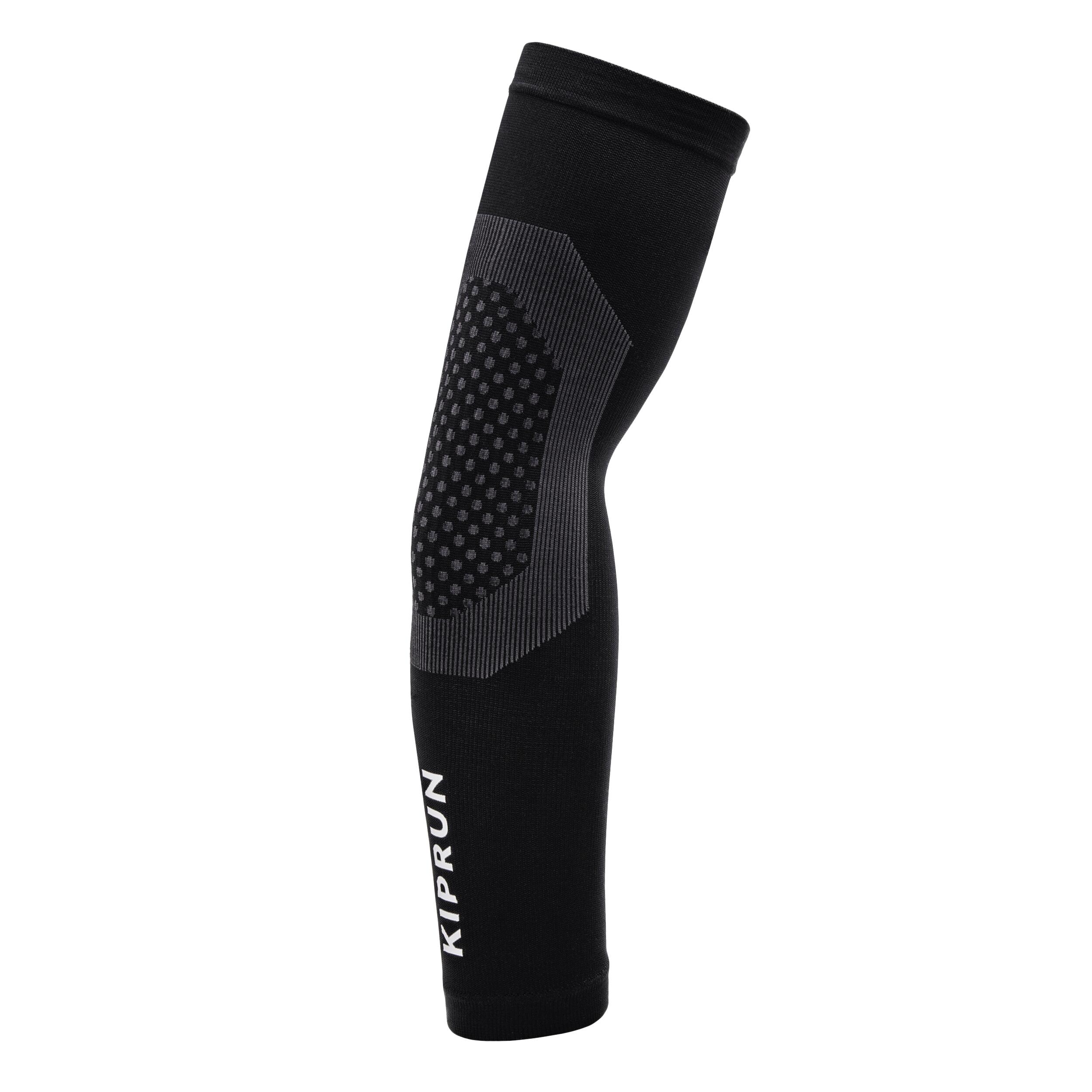
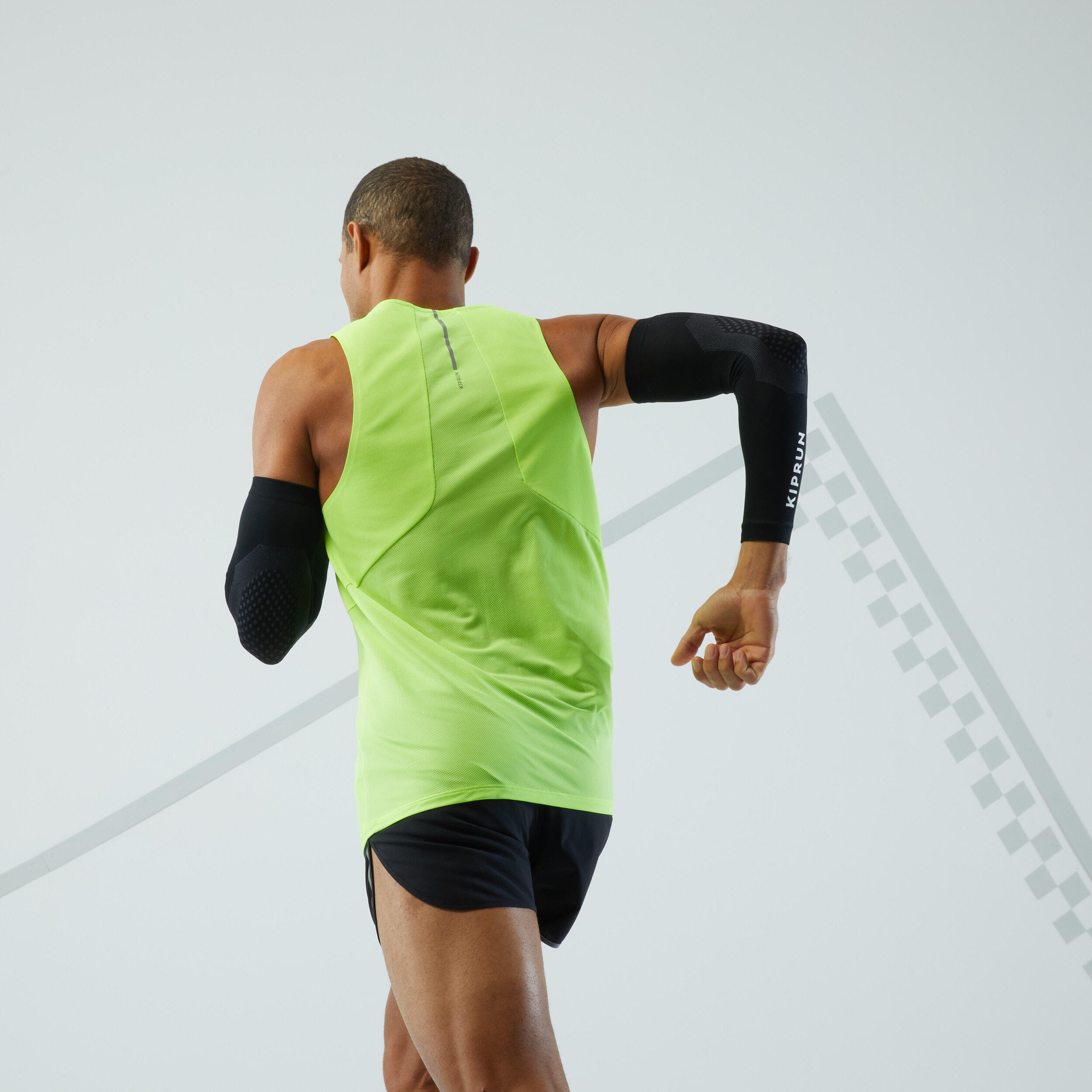
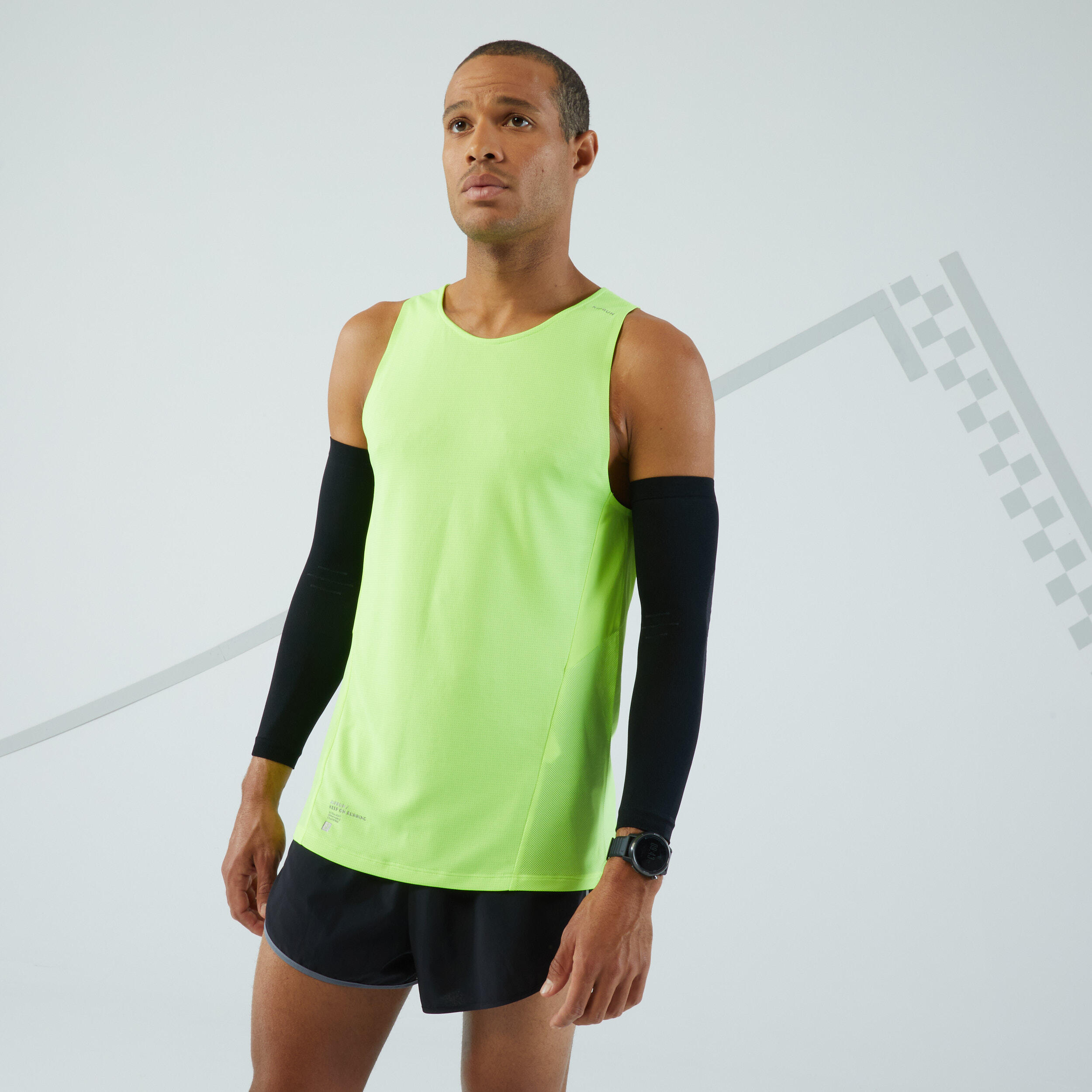
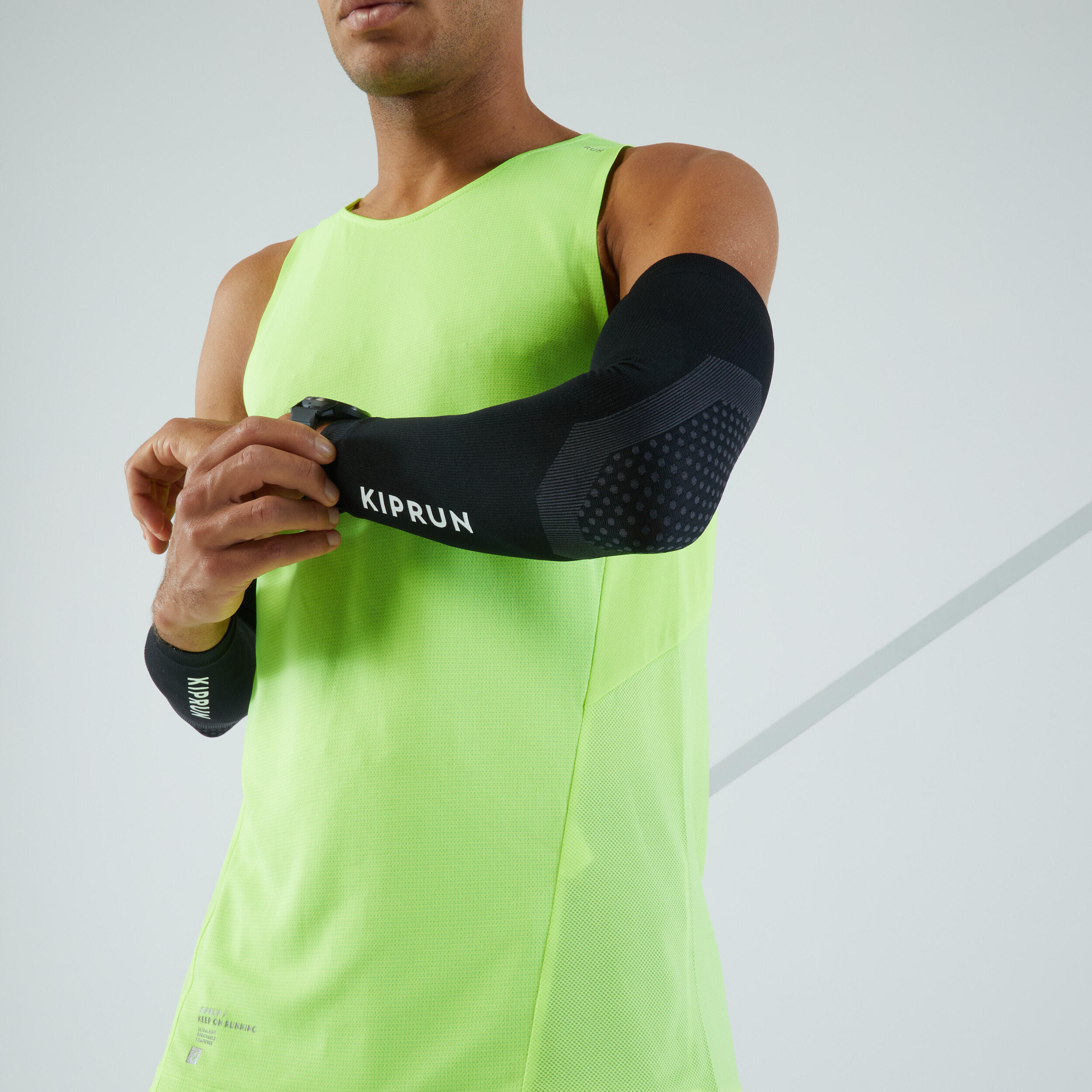
The KIPRUN model chosen here costs ≈ €10.50 and is designed for running in cool weather. The main material is 83% polyester, 13% polyamide and 4% elastane. Decathlon lists three basic benefits: warmth, sweat wicking and the ability to roll the arm warmers down to your wrists easily.
It is available in two double sizes, XS/S and M/L. For running, it is a simple solution with a good balance of price and usefulness. It can also be used on the bike, especially on easy rides and with moderate temperature changes, but it is not presented as a waterproof product or one with a windproof membrane.
The 8.8/10 score refers to this model as an affordable option. It does not mean it is the best arm warmer for every athlete or every condition; for cold alpine descents, a dedicated cycling model with stronger insulation and wind protection may make more sense.
Tribro verdict: temperature control is the real product
The value of arm warmers does not lie in a magic material or a logo. Their value is control: you can quickly cover or uncover roughly 15% of your body surface without changing your main layer.
For running, that means comfort at the start and the freedom to roll them down once you have warmed up. On the bike, it means adapting to a cold morning, a recovery ride that ends in the evening or the huge difference between a sweaty climb and a long, windy descent.
Studies support the importance of skin temperature, wind, moisture and clothing management. They do not show that a pair of arm warmers automatically makes you faster. But kit that helps you stay comfortable, without having to choose between overheating on the climb and freezing on the descent, is in practice one of the most useful little things you can keep in your pocket.
Studies and sources
Sources were checked in October 2026. Optimal temperatures are ranges observed in the populations and events analysed, not universal thresholds for every athlete. None of the studies below directly tests the KIPRUN model.
• **RIVM / US EPA – body segment surface area.** The arms excluding the hands make up roughly 14–15.5% of body surface area, depending on sex, percentile and dataset. See the table on NCBI Bookshelf
• **Arens E, Zhang H.** *The Skin's Role in Human Thermoregulation and Comfort.* A synthesis on heat exchange through the skin, clothing and regional thermal sensitivity. Read the paper
• **Fukazawa T, Havenith G.** *Differences in comfort perception in relation to local and whole body skin wettedness.* European Journal of Applied Physiology. 2009;106(1):15–24. DOI: 10.1007/s00421-009-0983-z. See it on PubMed
• **El Helou N et al.** *Impact of Environmental Parameters on Marathon Running Performance.* PLOS ONE. 2012. An analysis of 1,791,972 results, with optimal temperatures estimated between 3.8 and 9.9°C depending on level. Read the full study
• **Scheer V et al.** *Effects of Weather Parameters on Endurance Running Performance: Discipline-specific Analysis of 1258 Races.* Medicine & Science in Sports & Exercise. 2021. See it on PubMed
• **Valenzuela PL et al.** *Ambient Temperature and Field-Based Cycling Performance: Insights From Male and Female Professional Cyclists.* International Journal of Sports Physiology and Performance. 2022;17(7):1025–1029. DOI: 10.1123/ijspp.2021-0508. See it on PubMed
• **Corbett J, Barwood MJ, Tipton MJ.** *Physiological cost and thermal envelope: a novel approach to cycle garment evaluation during a representative protocol.* Scandinavian Journal of Medicine & Science in Sports. 2015;25(2):152–158. A protocol with flat, climb and simulated descent. See it on PubMed
• **Riera F et al.** *Impact of a Cold Environment on the Performance of Professional Cyclists: A Pilot Study.* Life. 2021;11(12):1326. See it on PubMed
• **Haymes EM et al.** *Effects of wind on the thermal and metabolic responses to exercise in the cold.* Medicine & Science in Sports & Exercise. 1982;14(1):41–45. See it on PubMed
• **KIPRUN arm warmers – product information:** price, sizes, composition and care. See the product on Decathlon
Note: Retailer links may be affiliate links. Prices and availability may change.