Reviews / Alergătorul Fericit (The Happy Runner) review: the book that helps you love the process, run better and build a healthy relationship with sport
Alergătorul Fericit (The Happy Runner) review: the book that helps you love the process, run better and build a healthy relationship with sport
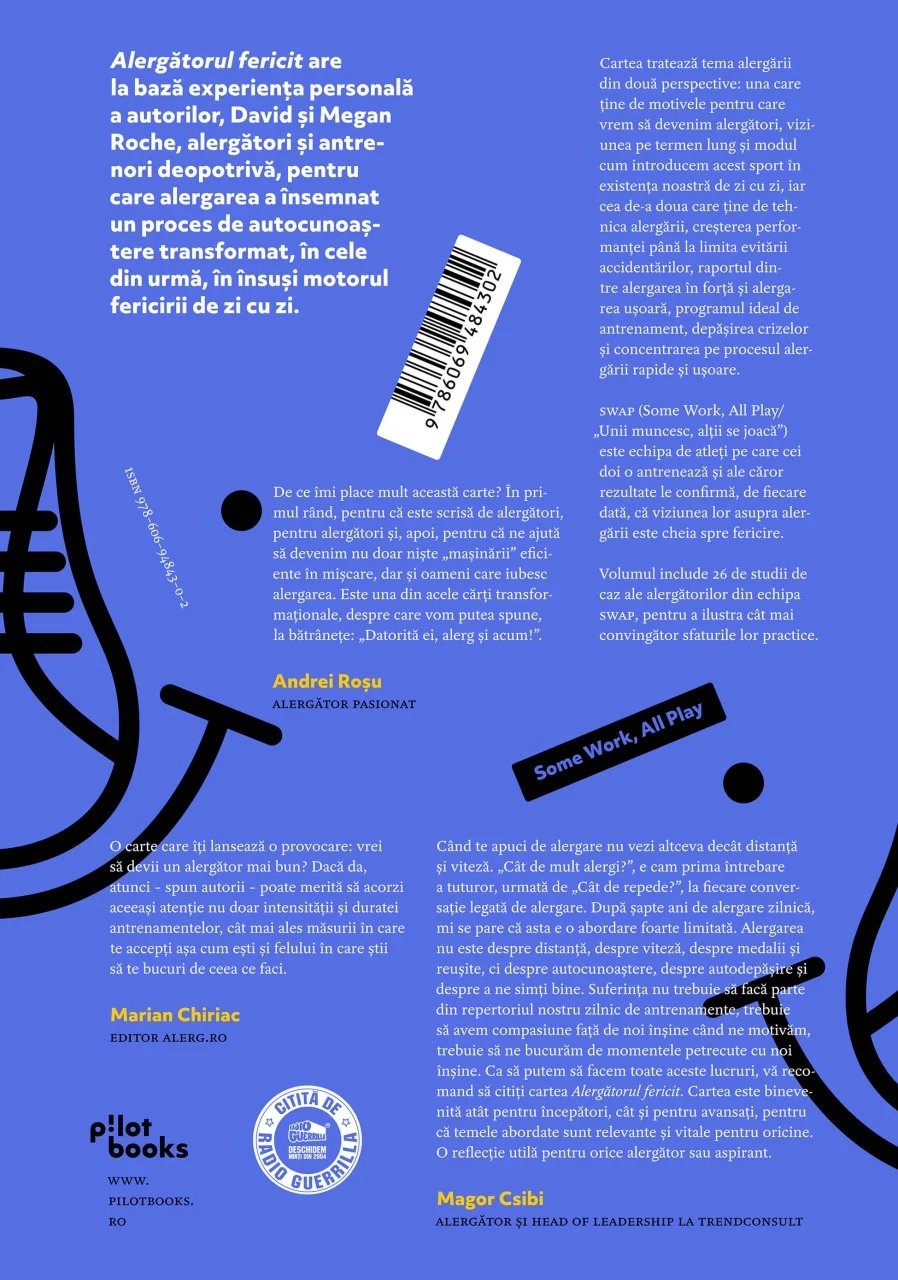
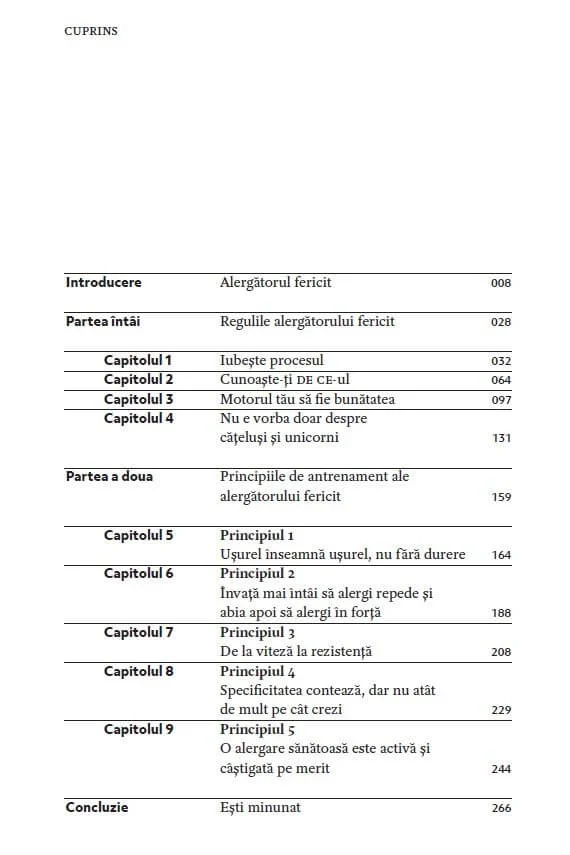
The Happy Runner by David Roche and Dr. Megan Roche – published in Romanian as Alergătorul Fericit – is one of the best books for people who want to improve their running without turning every session into a blind fight with numbers, pressure and comparison. The book brings together two worlds that are rarely held together: the joy of running and sustainable performance. The authors talk about motivation, runner identity, consistency, smart training, easy versus hard running, avoiding injuries and building a long-term perspective. The result is a very practical but also very human guide that can help you become faster and more resilient while being more at peace with the process.
Video (YouTube Shorts)
👍 Pros
- Combines the mental side of running with the practical side of training excellently
- Very useful for beginners, ambitious amateurs, marathon runners and endurance athletes
- Offers a healthy and rare perspective: performance without losing the joy
- Covers injury prevention, consistency and a long-term relationship with running
- Includes examples and case studies that make the ideas easier to understand and apply
- Helps you escape the toxic mindset based only on pace, volume and comparison
👎 Cons
- For some readers, the positive tone and the focus on enjoying the process may seem too idealistic at first
- Those looking purely for a very strict technical manual may feel the mindset part takes up a lot of space
- Some ideas are deliberately repeated around the same central philosophy
- It is not a book of rigid plans, but rather of principles and direction
Verdict
If you already run or want to build a serious and healthy relationship with running, The Happy Runner is worth reading. It is the kind of book that does not just tell you how to get better, but helps you understand why it is worth carrying on when motivation fluctuates, when comparison creeps in or when you run into frustration. For Tribro readers, it is one of the most valuable book recommendations on running, progress and sustainability: a book that teaches you to run better without forgetting why you started.
Gallery


What The Happy Runner is and why it deserves attention
The Happy Runner (published in Romanian as Alergătorul Fericit) was written by David Roche and Dr. Megan Roche. The book’s premise is extremely powerful: you can become a better runner not through more grim determination and more punishment, but through a healthier, smarter and more sustainable relationship with training and with yourself.
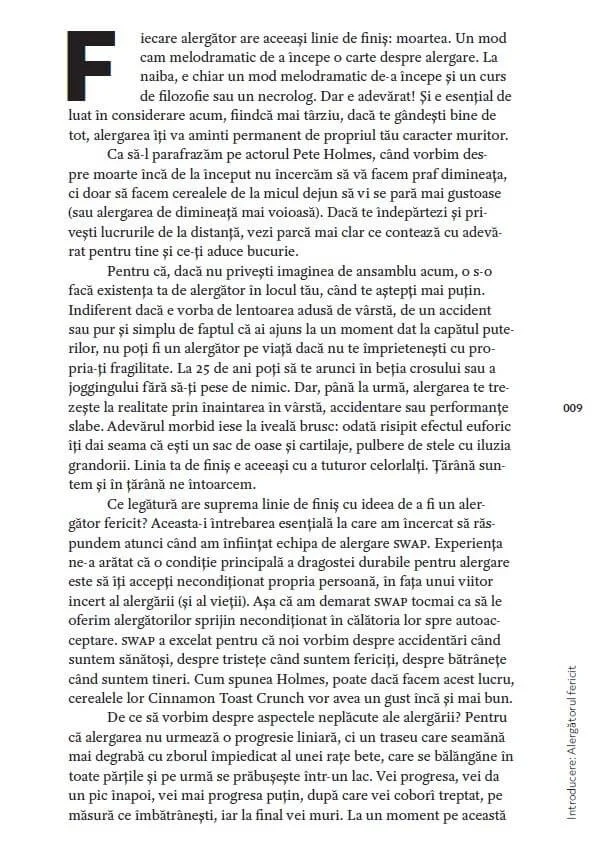
The book stands out because it does not reduce running to kilometres, pace and results. It treats it as a process of personal growth, discipline, joy and self-knowledge. That is exactly where its great value lies: it is not just about how you run, but about how you stay a runner for the long term.
A rare philosophy in the running world: love the process, not just the result
One of the most important ideas in The Happy Runner is that real progress comes more easily when you do not hate the process that is supposed to get you there. In many endurance cultures, athletes come to believe that their worth depends exclusively on times, podiums, volume or external validation.
David and Megan Roche propose something different: an approach in which performance and joy are not mutually exclusive. On the contrary, they feed each other. When you learn to enjoy running, to have compassion for your own journey and to build consistency without unnecessary drama, you become not only more at peace, but often better too.
The book talks about motivation, but not in a superficial way
A great merit of this book is that it avoids motivational fluff. It does not promise that if you think positively everything will magically fall into place. The authors discuss motivation in a mature, realistic way that is very useful for the everyday runner.
Their message is that runner identity is built over time, through repetition, through the way you talk to yourself, through small choices and through the ability to see the big picture. That is why the book is so valuable for anyone going through periods of feeling stuck, comparison, performance anxiety or mental fatigue in sport.
Smart training: easy running, progress, resilience and avoiding injuries
Besides the mindset part, The Happy Runner also contains a lot of practical substance. The authors discuss the balance between easy and hard running, how to build progress without forcing it unnecessarily, the risk of injury and how a runner can become faster and more resilient without self-destructing in the process.
This is an essential quality of the book: it does not stay at the level of beautiful philosophy. It also gets into the concrete side of training, but in an accessible and logical way, without burying you in jargon.
Why The Happy Runner is useful for marathon runners, trail runners and triathletes
Although the book is aimed primarily at runners, its ideas transfer very well to other endurance sports. For marathon runners, the message about consistency, patience and the balance between volume and recovery is extremely relevant. For trail runners, the SWAP philosophy and the emphasis on joy, adaptability and resilience are directly valuable.
For triathletes, the book is even more important than it seems at first glance. In a sport where the pressure to optimise everything is huge, The Happy Runner offers a healthy correction: progress does not come only from structure and hard work, but also from your psychological relationship with the process.
Case studies and real examples make the book much more convincing
Another very strong point is that the book is not based only on abstract ideas. It includes case studies and examples drawn from runners coached by the authors, which makes the messages much more credible and easier to take on board. You are not just reading principles – you see what they look like in the lives of real people with real challenges.
That makes the book warmer and more practical. Instead of talking down to you, it shows you that progress in running is rarely a straight line and that a healthy relationship with sport is not a luxury, but a foundation for lasting performance.
The authors’ tone: warm, intelligent and firmly anchored in real life
David and Megan Roche have a voice that feels different from many other sports books. They write neither in a cold, academic way nor in an aggressive, performance-driven way. They write with empathy, clarity and enough authority that you feel what they say has been tested in real life, not just nicely phrased.
That is exactly why the book reads so well. Even when it talks about mistakes, fears or self-sabotage, it does not make you feel judged. It makes you feel you have coaches by your side who truly understand why running can sometimes be hard and why it is still worth staying in the game.
Who The Happy Runner is for
The book is a good fit for:
- people who have just started running and want a healthy foundation;
- amateur runners who feel they have got lost in pressure, numbers and comparison;
- marathon and half-marathon runners who want to improve without burning out mentally;
- trail runners and endurance athletes looking for a more mature perspective;
- triathletes who want to apply principles of sustainability to their complex training too.
It is not only for those who want performance, nor only for those who want inspiration. It is for people who want both at the same time.
What sets The Happy Runner apart from other running books
Many running books lean heavily either towards plans, structures and methods, or towards inspirational stories. The Happy Runner achieves a rarer combination: it brings training principles, sports psychology, identity and joy together in a coherent, applicable and memorable form.
The big difference is that it does not start from the premise that you have to suffer more to deserve progress. It starts from the idea that a mentally healthy runner, built up patiently, can go further than one who relies solely on pressure and self-criticism.
A long-term relationship with running: the book’s most valuable message
Perhaps the most important thing this book offers is a long-term perspective. It does not just talk about your next race, your next PB or your next training block. It talks about how to live alongside running for years without turning it into a constant source of frustration.
For a great many runners, this is exactly where the break happens: they love the idea of progress, but end up losing the pleasure of the process. The Happy Runner is a very good antidote to that trap.
Conclusion: is The Happy Runner worth reading?
Yes. If you want a book that helps you run better, understand what motivates you and build a healthy relationship with sport, The Happy Runner is worth reading. It is one of those books that can have a real effect not just on your training, but on how you relate to progress, failure, comparison and discipline.
For Tribro, the verdict is simple: it is a very strong recommendation for runners, triathletes and active people who want more than simple technical advice. It is a book about running, but also about how to stay whole while trying to get better.
Note: Retailer links may be affiliate links. Prices and availability may change.