
This resource is informational. Test every strategy during long training sessions, not for the first time on race day. Adjust quantities for body weight, temperature, sweat rate, pace and digestive tolerance.
Keep the tools close—and the plan right on your bike.
Use the Tribro App for race-day and nutrition tools, and keep your Fueling Plan visible during the race with the Tribro sticker on your bike.


The core principle
For long-distance races, focus on three things: carbohydrates, fluids and sodium. Carbohydrates maintain energy, fluids limit dehydration, and sodiumm helps maintain electrolyte balance.
Practical rule: start conservatively, then increase gradually in training. If your stomach tolerates it well, you can increase carbohydrate intake, especially on the bike.
General hourly targets
| Context | Carbohydrates | Fluids | Sodium |
|---|---|---|---|
| Training sessions of 1–2 hours | 30–60 g / hour | 400–750 ml / hour | 300–700 mg / hour |
| Half Ironman | 60–90 g / hour | 500–900 ml / hour | 500–1,000 mg / hour |
| Full Ironman | 70–100 g / hour | 600–1,000 ml / hour | 600–1,200 mg / hour |
On very hot days, or if you sweat heavily, you may need more fluids and sodiumm. On cold days you may need less fluid, but carbohydrates remain important.
Half Ironman / 70.3 plan
Before the start
- 3–4 hours before: a light, carbohydrate-rich breakfast.
- 15–20 minutes before the start: one gel or 20–30 g of carbohydrate, if you have tested this before.
- Drink small amounts regularly; do not try to catch up on hydration in the final ten minutes.
Bike—the best time to fuel
The bike is the easiest place to eat and drink. For a 70.3, a good target is:
- 60–90 g carbohydrate / hour
- 500–900 ml fluid / hour
- 500–1,000 mg sodiumm / hour
A simple bike example
Each hour: one bottle with 60 g of carbohydrate and 500–750 ml of fluid, plus a 20–30 g carbohydrate gel if you want to reach 80–90 g per hour.
Run—keep it simple
The stomach is more sensitive on the run. Use gels, sports drink and water.
- 45–75 g carbohydrate / hour
- 400–800 ml fluid / hour
- 400–900 mg sodiumm / hour
Example: one gel every 25–30 minutes, plus water at every aid station.
Full Ironman / 140.6 plan
Before the start
- 3–4 hours before: a carbohydrate-rich breakfast low in fibre and fat.
- 15–20 minutes before: 20–30 g of carbohydrate, only if tested in training.
- Do not start dehydrated, but do not overfill your stomach with fluid either.
Bike—build energy for the marathon
In a Full Ironman, the bike is not merely the second leg. It is where you prepare your run. If you underfuel here, the marathon becomes much harder.
- 80–100 g carbohydrate / hour
- 600–1,000 ml fluid / hour
- 600–1,200 mg sodiumm / hour
A simple bike example
Each hour: one bottle with 70–80 g of carbohydrate plus one 20–25 g gel. In hot conditions, add sodiumm separately or use an electrolyte drink.
Run—maintain, do not force it
During the marathon, the aim is to keep taking in energy without forcing digestion.
- 60–80 g carbohydrate / hour
- 500–900 ml fluid / hour
- 500–1,000 mg sodiumm / hour
Example: one gel every 25 minutes, plus sports drink or water at aid stations. If your stomach shuts down, temporarily reduce intensity and return to plain fluids.
What to test in training
- Which products you tolerate: gels, carbohydrate drink, bars and bananas.
- How many grams of carbohydrate per hour you can tolerate without digestive problems.
- How much you drink per hour at different temperatures.
- How much sodiumm you need if you sweat heavily or leave white salt marks on your kit.
- How often you eat: every 10, 15, 20 or 30 minutes.
Common mistakes
- Starting to eat too late on the bike.
- Drinking only water for many hours without sodiumm.
- Trying new products on race day.
- Eating food that is too solid or too fatty on the bike.
- Forcing the run when your stomach shows signs that it is no longer processing fuel well.
- Copying someone else's plan without testing it on your own body.
Quick plan template
| Timing | What to do |
|---|---|
| 3–4 hours before | A simple, tested, carbohydrate-rich breakfast. |
| 15–20 minutes before | Optional: a gel or 20–30 g of carbohydrate. |
| Bike | Eat and drink consistently every 10–15 minutes. |
| T2 | Do not rush solid food; switch to gels and fluids. |
| Run | A gel every 25–30 minutes, water or sports drink at aid stations, controlled pace. |
| After the race | Carbohydrates, protein, fluids and sodiumm for recovery. |
Bike fuelling sticker
A good fuelling plan only helps if you can follow it. During a race, when you are tired, when it is windy or you are focused on power, it is easy to forget to drink, take a gel on time or use the ideal moment before an aid station.
That is why a sticker on the bike can be a simple and effective reminder. Place it on the top tube, near the cockpit or somewhere visible so you can quickly check what to do without taking out your phone or relying only on memory.
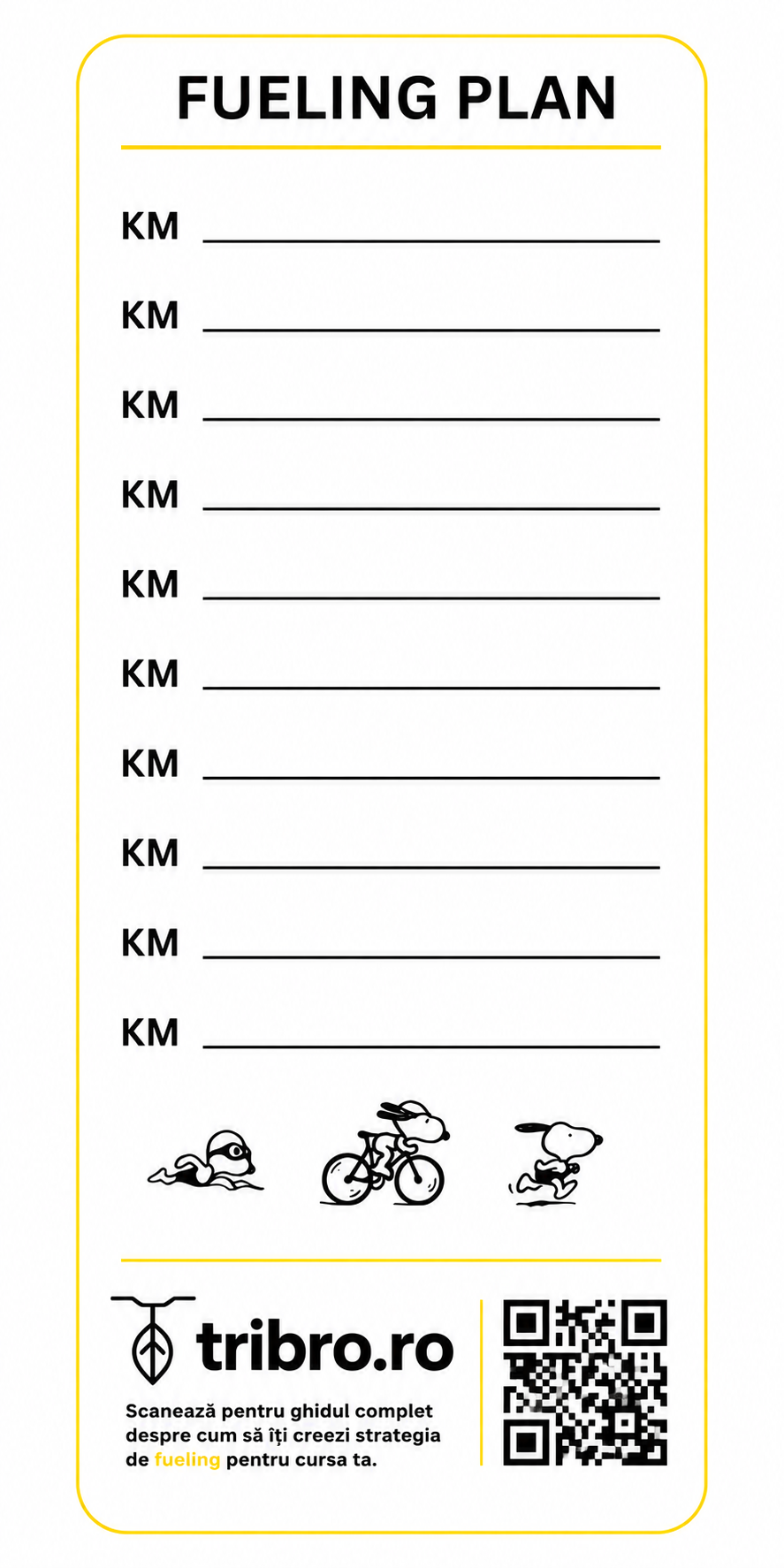
How to use it during a race
- Write down key race distances: aid stations, places to take gels and moments to check your plan.
- Mark a gel 1–2 km before an aid station so you have time to take it and then drink water.
- It reminds you to drink consistently, not only when you feel thirsty.
- It helps divide the race into small, manageable segments.
- It reduces the risk of fuelling too late, one of the most common long-distance racing mistakes.
- It lets you adapt the plan to the actual course rather than generic time intervals.
- Use a permanent or washable marker depending on the sticker material and how you plan to reuse it.
Completed example
The example below shows how to fill in the sticker for a race where you want to connect fuelling with course distances—for example, a gel before an aid station, a fluid check in each segment and a sodiumm reminder in the second half of the bike.
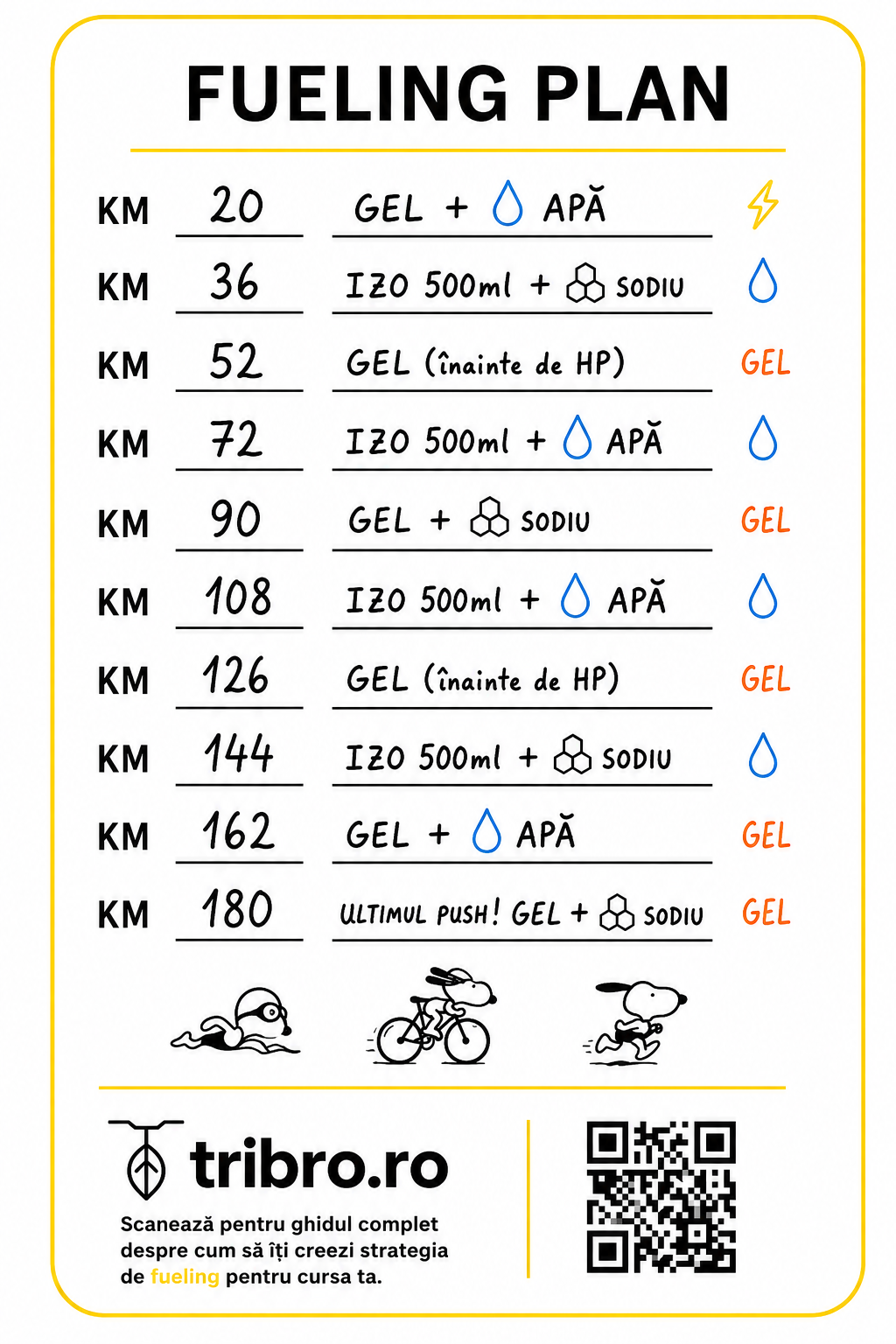
The aim is not to overload the sticker with details, but to have 5–10 clear prompts: when to drink, when to take a gel, where the aid stations are and where to check whether you are still on target for carbohydrates, fluids and sodiumm.
The best fuelling plan is not the most aggressive one, but the one you can execute consistently without digestive problems. Test, record and adjust.